


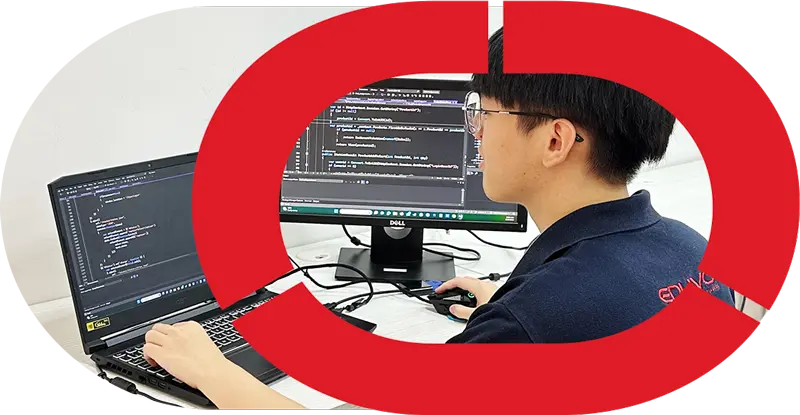


Cybersecurity vs Software Engineering in Malaysia
Confused between cybersecurity and software engineering? Compare salary, skills, job demand, difficulty, and the fastest pathway after SPM.

- Software engineering builds apps and systems; cybersecurity protects those systems from threats.
- JobStreet 2026 lists Software Engineer salary at RM 4,300–6,000/month.
- Cyber Security Engineer roles show RM 5,750–8,250/month, but entry can require broader IT fundamentals.
- Beginners often start faster with software engineering because portfolio projects are easier to show.
- At Eduvo Academy, students aged 16+ can start without SPM results through a practical one-year pathway.
Cybersecurity vs Software Engineering: What Is the Difference?
Software engineering is about building digital products; cybersecurity is about protecting digital systems. Both careers use logic and technology, but the daily work feels very different.
A software engineer writes code to create websites, mobile apps, internal business systems, payment platforms, dashboards, automation tools, and APIs. Your work is measured by whether the product works, loads fast, is easy to maintain, and solves a user problem.
A cybersecurity professional protects systems from attacks, data leaks, malware, account compromise, and misconfiguration. Your work is measured by whether the organisation can detect threats, reduce risk, respond to incidents, and keep systems compliant.
Swipe horizontally to view the full comparison table.
| Factor | Software Engineering | Cybersecurity | What It Means for You |
|---|---|---|---|
| Main goal | Build software products | Protect systems and data | Choose building if you like creating; choose security if you like defending and investigating. |
| Daily work | Coding, debugging, testing, feature development | Monitoring alerts, analysing risks, hardening systems, incident response | Software work is project-based; security work can be more operational and urgent. |
| Beginner visibility | High: GitHub projects, web apps, portfolio demos | Medium: labs, write-ups, certifications, blue-team practice | Software portfolios are usually easier for fresh graduates to show recruiters. |
| Learning curve | Start with one language, then expand | Needs networks, OS, cloud, risk, tools, and sometimes coding | Cybersecurity often becomes stronger after you understand how systems are built. |
| Typical first roles | Junior Developer, Software Engineer, Web Developer | SOC Analyst, Security Analyst, Junior Security Engineer | Both can lead to strong IT careers if you build practical evidence. |
Build vs protect
- Software Engineering
- Builds apps, systems, APIs, websites, and product features.
- Cybersecurity
- Protects users, data, networks, cloud systems, and business operations.
Creation vs investigation
- Software Engineering
- Coding, debugging, testing, and shipping features.
- Cybersecurity
- Monitoring, threat analysis, risk reduction, and incident response.
Portfolio vs labs
- Software Engineering
- GitHub apps and deployed projects are easy to show.
- Cybersecurity
- CTF write-ups, home labs, SOC practice, and certifications help.
Which Career Has Better Job Demand in Malaysia?
Both careers are in demand, but software engineering has more visible entry-level openings while cybersecurity has a sharper talent shortage. The better choice depends on whether you want a broader first-job market or a more specialised security track.
In May 2026, JobStreet showed thousands of software engineering roles across Malaysia and more than a thousand cyber security engineer roles. At the same time, Malaysia’s national digital plans and cybersecurity workforce discussions repeatedly highlight the need for more cybersecurity knowledge workers.
Swipe horizontally to view the full job demand table.
| Demand Signal | Software Engineering | Cybersecurity | Interpretation |
|---|---|---|---|
| JobStreet job count | About 3,380 Software Engineer jobs in Malaysia | About 1,425 Cyber Security Engineer jobs in Malaysia | Software roles appear more numerous for general entry routes. |
| Junior openings | Many junior developer and software engineer listings | About 828 Junior Cyber Security Engineer jobs listed | Cyber has openings, but many employers still prefer strong IT fundamentals. |
| National talent priority | Digital companies need developers, cloud, AI, and product builders | Malaysia targeted 20,000 cybersecurity knowledge workers by 2025 | Cybersecurity is a national priority because digital adoption increases risk. |
| First-job accessibility | Generally easier to prove skill with portfolio projects | Often needs labs, networking knowledge, and security tooling | Software engineering is commonly the smoother zero-to-first-job route. |
More visible openings
- 2026 signal
- JobStreet showed about 3,380 Software Engineer jobs in Malaysia.
- What it means
- There are many product, web, backend, and full-stack routes.
Sharper talent shortage
- 2026 signal
- JobStreet showed about 1,425 Cyber Security Engineer jobs in Malaysia.
- What it means
- Demand is strong, but many roles expect security foundations and IT maturity.
Malaysia’s digital economy is also expanding through Malaysia Digital Status companies, cloud investment, AI adoption, and data centre growth. Every new system needs builders, and every connected system also needs protection. That is why both paths can be future-facing.
Which Path Pays More in Malaysia in 2026?
Cybersecurity can show a higher average salary at engineer level, but software engineering offers a wider number of beginner-friendly roles. Salary should not be your only decision factor.
JobStreet Malaysia’s May 2026 salary pages list Software Engineer roles at RM 4,300–6,000/month and Software Developer roles at RM 3,500–6,000/month. For Cyber Security Engineer, JobStreet lists RM 5,750–8,250/month. Indeed Malaysia lists Cybersecurity Analyst average salary at RM 65,479/year nationwide and RM 72,251/year in Kuala Lumpur.
Swipe horizontally to view the full salary table.
| Role / Level | Monthly Salary Signal | Common Job Titles | Source Basis |
|---|---|---|---|
| Software Developer | RM 3,500–6,000/month | Web Developer, App Developer, Junior Developer | JobStreet Malaysia salary insights, May 2026 |
| Software Engineer | RM 4,300–6,000/month | Software Engineer, Backend Engineer, Full-stack Developer | JobStreet Malaysia salary insights, May 2026 |
| Cybersecurity Analyst | About RM 5,457/month nationwide; about RM 6,021/month in KL | SOC Analyst, Security Analyst, Monitoring Analyst | Indeed Malaysia annual average converted to monthly |
| Cyber Security Engineer | RM 5,750–8,250/month | Security Engineer, Cyber Defence Engineer, Network Security Engineer | JobStreet Malaysia salary insights, May 2026 |
RM 3,500–6,000/month
- Common titles
- Web Developer, App Developer, Junior Developer.
- Best for
- Beginners building visible coding projects.
RM 4,300–6,000/month
- Common titles
- Backend Engineer, Full-stack Developer, Software Engineer.
- Best for
- Students who enjoy building products and solving logic problems.
About RM 5,457–6,021/month
- Common titles
- SOC Analyst, Security Analyst, Monitoring Analyst.
- Best for
- Students who like investigation, alerts, and system defence.
RM 5,750–8,250/month
- Common titles
- Security Engineer, Cyber Defence Engineer, Network Security Engineer.
- Best for
- Learners who can combine systems, networks, tools, and risk thinking.
These are market salary signals, not personal salary guarantees. Your actual offer depends on your portfolio, interview performance, English communication, internship quality, location, and whether you can show practical skills.
Which Skills Do You Need for Each Path?
Software engineering needs coding depth; cybersecurity needs system understanding plus defensive thinking. The strongest students eventually learn some of both.
If you choose software engineering, your first goal is to become good at building. Learn one beginner-friendly language, build web applications, understand databases, use Git, and deploy projects. If you choose cybersecurity, you still need technical fundamentals: networking, operating systems, cloud basics, logs, vulnerabilities, authentication, and security tools.
Swipe horizontally to view the full skills table.
| Skill Area | Software Engineering Focus | Cybersecurity Focus | Why It Matters |
|---|---|---|---|
| Programming | Python, JavaScript, Java, frameworks | Python scripting, Bash, basic web code | You need to understand how software behaves before you can build or defend it. |
| Web and databases | HTML, CSS, APIs, SQL, backend logic | Web vulnerabilities, SQL injection, access control | Most modern attacks and apps involve web systems and data. |
| Tools | Git, GitHub, VS Code, testing tools, deployment | SIEM, EDR, vulnerability scanners, logs, firewall tools | Employers want proof that you can use real workplace tools. |
| Systems | Cloud basics, containers, server-side deployment | Linux, Windows, networking, identity, cloud security | Cybersecurity requires knowing what is normal before spotting what is abnormal. |
| Soft skills | Problem solving, teamwork, documentation | Calm response, communication, risk reporting | Both careers require explaining technical problems clearly. |
Both need code
- Software
- Python, JavaScript, Java, frameworks.
- Cybersecurity
- Python scripting, Bash, basic web code.
Cyber needs wider foundations
- Software
- Cloud basics, deployment, server-side app logic.
- Cybersecurity
- Linux, Windows, networks, identity, cloud security.
Use workplace tools early
- Software
- Git, GitHub, VS Code, test tools, CI/CD basics.
- Cybersecurity
- SIEM, logs, vulnerability scanners, EDR, firewall concepts.
Which Path Should You Choose After SPM?
If you are starting from zero after SPM, software engineering is usually the clearer first step. You can build projects quickly, learn job-ready tools, and later branch into cybersecurity if you enjoy security work.
This does not mean cybersecurity is a bad choice. It means cybersecurity is often stronger when built on top of practical IT, networking, or software foundations. To protect an application, you need to understand how applications are built. To monitor a network, you need to know how normal network behaviour looks.
Choose Software Engineering if...
You enjoy coding, logic, building apps, designing features, solving bugs, and seeing your work become a usable product.
Choose Cybersecurity if...
You enjoy investigation, systems, risk, defence tools, ethical hacking concepts, incident response, and constantly changing threats.
For students with weak SPM results, the important thing is not to wait too long. At Eduvo Academy, students aged 16 and above can start without SPM result requirements. That matters because the IT industry rewards skills, projects, discipline, and internship experience more than exam history alone.
What Is the Fastest Practical Way to Start?
The fastest practical route is to build strong software fundamentals first, then decide whether to specialise in development or security. This gives you more first-job options.
Eduvo Academy’s Professional Diploma in Software Engineering is a one-year pathway designed for students who want practical skills, real projects, and an internship-ready portfolio. For students who want a higher-level pathway, Eduvo also offers the Professional Degree in Software Engineering, also completed in one year.
The advantage of starting with software engineering is flexibility. You can apply for junior developer roles, web developer roles, app developer roles, QA automation roles, or later specialise into application security, cloud security, secure coding, DevSecOps, or cybersecurity analysis.
How Can You Build a Portfolio Before Graduation?
Your portfolio is what turns “I studied IT” into “I can do the work.” Whether you choose software engineering or cybersecurity, you need proof.
For software engineering, build three to five projects: a personal website, a CRUD web app, a database-backed dashboard, a simple API, and one group project. Put the code on GitHub, write clear README files, and deploy at least one project online.
For cybersecurity, build a learning portfolio with lab write-ups, network diagrams, vulnerability explanations, log analysis notes, and secure coding fixes. Do not publish anything that teaches harmful misuse. Focus on defensive learning, ethical lab environments, and clear explanations.
Eduvo’s Action Learning approach supports this by helping students learn through doing, not just listening. You build, test, troubleshoot, present, and improve. That is exactly the behaviour employers look for.
Frequently Asked Questions
Is cybersecurity better than software engineering in Malaysia?
Neither path is automatically better. Cybersecurity is better if you enjoy investigation, risk, networks, defence tools, and continuous monitoring. Software engineering is better if you enjoy coding, building applications, debugging, and improving products. In Malaysia, both paths have strong demand, but software engineering is usually easier to start from zero because beginners can build visible projects earlier.
Which pays more in Malaysia, cybersecurity or software engineering?
Based on 2026 salary listings, cybersecurity roles often show a higher average range at the engineer level, while software engineering has a wider number of entry-level openings. JobStreet Malaysia lists Cyber Security Engineer roles around RM 5,750 to RM 8,250 per month and Software Engineer roles around RM 4,300 to RM 6,000 per month. Actual salary depends on skills, portfolio, location, certifications, and experience.
Is cybersecurity harder than software engineering?
Cybersecurity can feel harder for beginners because it requires understanding systems, networks, operating systems, cloud, risk, and sometimes coding before you can defend them well. Software engineering is also challenging, but beginners can usually start with one programming language, build small projects, and improve through practice. A practical starting route is to learn software fundamentals first, then add security skills later.
Can I study software engineering or cybersecurity without good SPM results?
Yes. At Eduvo Academy, students aged 16 and above can start an IT pathway without SPM result requirements. This makes a practical TVET route possible for students who want to enter technology through skills, projects, and internship experience instead of waiting for a traditional academic pathway.
Should I learn coding before cybersecurity?
Yes, learning coding first is helpful even if your final goal is cybersecurity. Python, JavaScript, SQL, Git, and basic web development help you understand how software works, how vulnerabilities appear, and how attackers think. You do not need to become a senior developer first, but software fundamentals make cybersecurity learning much stronger.
Which Eduvo course should I choose for these careers?
If you want to become a developer, start with the Professional Diploma in Software Engineering or Professional Degree in Software Engineering. If you are still deciding between systems, support, networking, and software, speak with Eduvo Academy first so the team can help you choose the pathway that matches your strengths.
References
- Software Engineer Salary in Malaysia, May 2026, JobStreet Malaysia. View source
- Software Developer Salary in Malaysia, May 2026, JobStreet Malaysia. View source
- Cyber Security Engineer Salary in Malaysia, May 2026, JobStreet Malaysia. View source
- Cybersecurity Analyst Salary in Malaysia, May 2026, Indeed Malaysia. View source
- Global Shortage of Cybersecurity Talent, Ministry of Communications Malaysia, 2025. View source
- Malaysia Digital Economy Blueprint, Ministry of Economy Malaysia. View source
- Salaries and Wages Survey Report 2024, Department of Statistics Malaysia. View source
- Malaysia Digital Companies, Q1 2026, Malaysia Digital Economy Corporation. View source


